
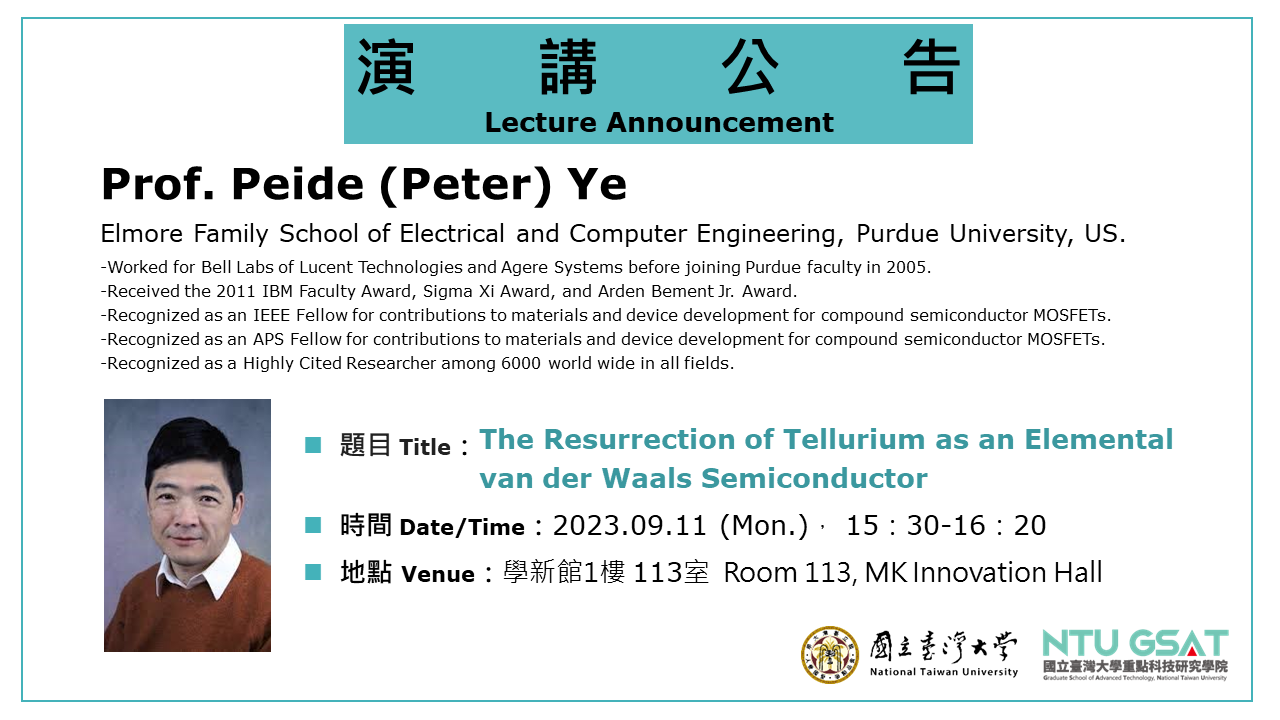
The Resurrection of Tellurium as an Elemental van der Waals Semiconductor
Peide (Peter) Ye
Elmore Family School of Electrical and Computer Engineering, Purdue University, USA
The graphene boom has triggered a widespread search for novel elemental van der Waals materials thanks to their simplicity for theoretical modelling and easy access for material growth. Group VI element tellurium is an unintentionally p-type doped narrow band gap semiconductor featuring a one-dimensional chiral atomic structure which holds great promise for next-generation electronic, optoelectronic, and piezoelectric applications. In this talk, we first review recent progress in synthesizing atomically thin Te two-dimensional (2D) films and one-dimensional (1D) nanowires. Its applications in field-effect transistors and potential for building ultra-scaled Complementary metal–oxide–semiconductor (CMOS) circuits are discussed. We will also overview the recent study on its quantum transport in the 2D limit and progress in exploring its topological features and chiral related physics. We envision that the breakthrough in obtaining high-quality 2D Te films will inspire a revisit of the fundamental properties of this long-forgotten material in the near future.
Dr. Peide (Peter) Ye is Richard J. and Mary Jo Schwartz Professor at School of Electrical and Computer Engineering at Purdue University. His research focuses on atomic layer deposition and its integration on various novel channel materials including III-V, Ge, 2D materials and complex oxides. He obtained his Ph.D. from Max-Planck Institute for Solid State Research in Germany and postdoc training at NTT Basic Research Laboratory, National High Magnetic Field Laboratory and Princeton University. He worked for Bell Labs of Lucent Technologies and Agere Systems before joining Purdue faculty in 2005. Prof. Ye received the 2011 IBM Faculty Award, Sigma Xi Award and Arden Bement Jr. Award. He is IEEE Fellow and APS Fellow for his contributions to materials and device development for compound semiconductor MOSFETs. Prof. Ye is also recognized as a Highly Cited Researcher among 6000 world wide in all fields.